While both Centrifugal Safety Locks (e.g., LSL series) and Tilt-sensing / Anti-tilt Safety Locks (e.g., LSB/LST series) serve as certified fall arresters, they operate on completely different trigger mechanisms.
[caption id="" align="aligncenter" width="500"]
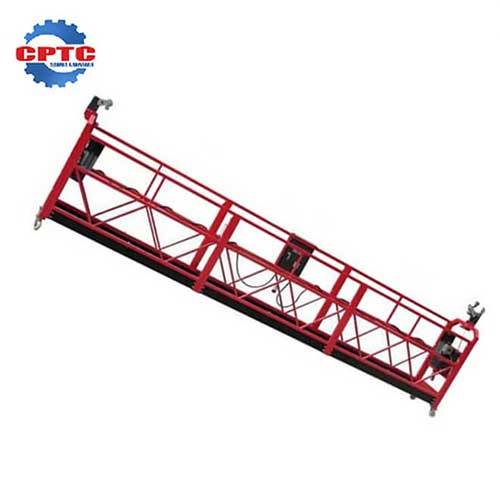 ZLP Series Suspended Platform[/caption]
How They Work
1. Tilt-sensing Locks (Anti-tilt Type)
Trigger Mechanism: Responds to the angular inclination of the platform.
Activation Threshold: Triggers automatically when the platform tilts between 3° and 8°.
How It Operates: A swing arm mechanism rides on the working wire rope. If one side of the platform drops due to a broken cable or hoist failure, the tilting arm rotates and immediately clamps the secondary safety wire rope on that end, arresting the tilt before workers or gear slide off.
2. Centrifugal Safety Locks (Speed-sensing Type)
Trigger Mechanism: Responds to over-speed descent / free-fall velocity.
Activation Threshold: Triggers when the platform’s descent speed exceeds roughly 22–25 m/min.
How It Operates: Internal weights rotate with the movement of the wire rope. When speed exceeds the safety threshold, centrifugal force throws flyweights outward to engage a ratchet/brake jaw, clamping the safety wire rope within 100 mm. It also features a manual locking lever.
Feature Comparison
| Feature | Anti-Tilt Safety Lock (LSB / LST) | Centrifugal Safety Lock (LSL) |
| Primary Trigger | Platform tilt angle ($3^{circ} - 8^{circ}$) | Excess downward speed ($> 25text{ m/min}$) |
| Main Threat Handled | Single cable snap, uneven motor slip, asymmetrical load | Total cable break (both sides), simultaneous hoist failure |
| Response Time | Almost instantaneous upon tilting | Requires a short free-fall distance to build activation speed |
| Manual Override | Limited | Yes (manual lock lever available) |
| Sensitivity to Vibration | Low (unaffected by smooth vertical motion) | Can trigger during sudden jerks if set too sensitive |
Which is Safer for a ZLP800 Platform?
For the ZLP800—a heavy-duty suspended platform rated for up to $800text{ kg}$ with working lengths up to 7.5 meters—Tilt-sensing (Anti-tilt) locks are generally considered safer and are the industry standard.
Why Anti-Tilt Locks Win on Long Platforms:
The Most Common Hazard is Asymmetrical Failure: In real-world suspended cradle operations, catastrophic simultaneous double-cable snaps are rare. The most frequent emergency is a single-side cable breakage or one motor slipping/stalling.
Preventing Ejection: On a 6-to-7.5-meter platform, a $5^{circ}$ slope creates a steep decline. Without an anti-tilt lock, workers, heavy tools, and material can slide toward the low end long before the dropping side accelerates fast enough to trigger a centrifugal lock. An anti-tilt lock catches this shift within degrees.
Immediate Strain Mitigation: By locking the lower end as soon as a $3^{circ}–8^{circ}$ tilt occurs, it keeps the structural frame of the ZLP800 from experiencing severe torsional twisting.
Safety Best Practice: While Anti-Tilt locks (LSB/LST series) are standard on most ZLP800 setups, modern regulations (e.g., EN 1808) mandate daily pre-operation testing and periodic annual calibration for all lock mechanisms.